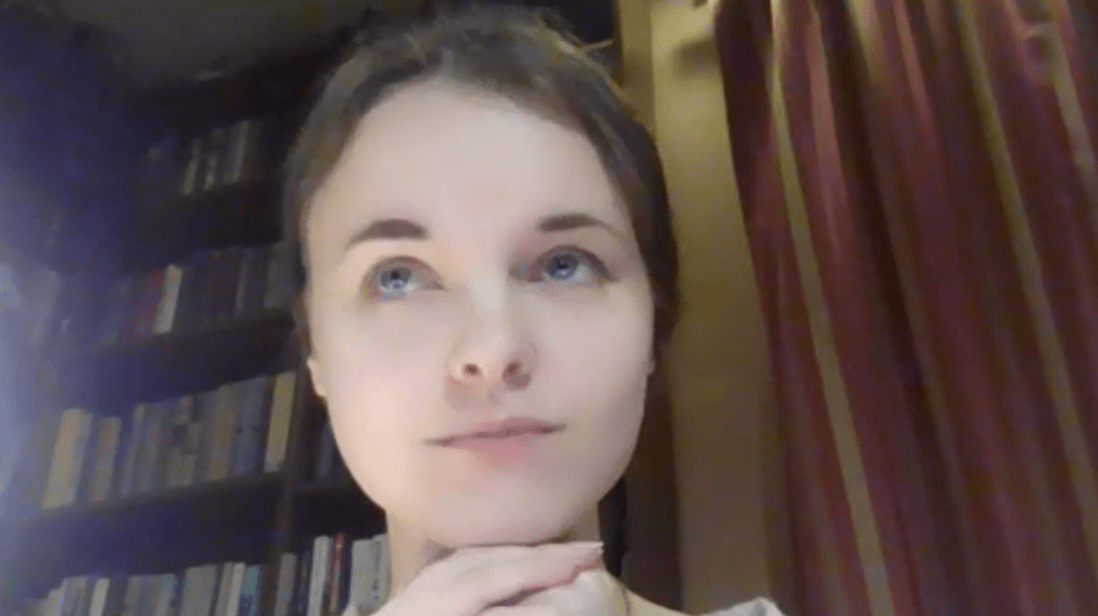
If not me, then who?  

On International Women’s Day earlier this week, I had the opportunity to speak to Olga, 23. Originally from Lugansk in Donbass, this is the second Russian invasion she’s lived through. Today she volunteers at the train station in Lviv near the Polish border, helping a seemingly endless stream of Ukrainian refugees flee the country under Russian attack. 

Here is some of what she has to say:

For me, this is like dejà vu because I’ve already seen it.  I  was 15 when it started in Lugansk, where I lived, in the Donbass region. It was the winter of 2013 when it all began to crash. I was in the 10th grade. We had our dreams about exams and how we will celebrate the end of the year. 

Then all of a sudden, every lesson in school starts to begin with questions of – is Ukraine going to be in the European Union or going to go with Russia, and so on? And this was not what we, 15-year-olds, were interested in. We wanted to talk about movies and books. But all of that just vanished in a moment.

I turned 16 in June 2014. A week after my birthday, I was walking through the city to my home and a bombing began. And my parents just started to worry that one day it might happen that I will not come home. Because men decided to do these horrible things.

So we came to Lviv. I thought it would be just for two weeks. We actually packed our bags for just two weeks. It was only me and my mom who left the city and my father and our two cats stayed in Lugansk.

Then, as the weeks became months, we decided that I should go to school in Lviv. And one day, it was September 1st, the first day of school of my last year, and my mother told me: we’re staying here, and you will not see your home in the near future. 

And actually, I didn’t see it for five years. I am quite a strong person, but this was a time when I cried almost every day. Really, my childhood came to an end at the age of 16. 

All my future was determined by the war. At the time when I had to choose what speciality I should study in university, I chose international relations, which now I have a masters degree in. I chose it to understand for myself how the war happens, and to help explain to other people how it happens. 

It was the second year of my bachelors degree, when I was preparing for some workshops and conferences, and I just looked at the whole situation and I understood that there is nothing we can do to stop all of this. It had already begun. We saw this war. We saw these unsolved points with Crimea and with Donbass. It is like an illness. Like cancer, it started, and then it spread, and now it’s everywhere.

I chose to volunteer in the train station in Lviv because in 2014, I was only 16, and I was a person who needed help. Somebody helped me and my mother – gave us food and a home and comforted us. 

Right now, I am able to give back. I can explain to those people from Kharkiv, from Kyiv, that, yes, it’s horrible, I understand you, but there are a lot of people around who can help you. Look at me. I was in the same situation and I’m right now here in front of you . . . I will help you if you need. If you need my hand, you just can take it.

People are dying. People are broken. 

I can be an example. If not me, then who? 

As a child in Lugansk

Seeing these people in the train station, a lot are angry and stressed. Sometimes, they cannot control what they’re feeling. They are scared and they can’t even consider taking help. So we just ask questions; where are you from? How was the road? Do you want something to eat? Just to distract them, to help them to understand that they’re not in Kharkiv, they’re not in Kyiv, they’re here in Lviv and they’re aren’t any bombs right now. They’re in a safe and calm place. 

By helping them, I feel that I give to my country. Our men are in the army right now. They are protecting us. Today is International Women’s Day. And we are doing our part. This is our women’s army. This is our battlefield actually – to help those who are suffering from this war. 

I will stay as long as I can. I had the possibility to leave the country the first day. But I didn’t do it in 2014 and I won’t now. I choose my country. Eight years ago, my parents gave everything – all that they have – to give me the possibility to live here, and to get a Ukrainian education. 

Today I feel responsible to show them that it was the right choice. That it was not in vain. They invested in me and in my country. So I’ll do everything I can to stay here, to work here, to volunteer here. To deal with this.

I think it’s important for the world to know that  – well, don’t take your life and peace in your country and your family for granted. Because as you can see, it can change at any time. One day, you have plans to go to work or drink coffee with a friend or travel to Kyiv. And then you wake up and you see that everything is gone. 

Right now we would give everything – prosperity and . . . well, anything – just to have peace.
Small Ordinary Heroes

Featured

Tetyana Struck, a translator who lives in Lviv, Ukraine, took the time to speak to me after a long day settling female refugees who had come by train from the bombarded city of Kharkiv to stay with Tetyana’s family before making their way to the Polish border. Tetyana’s 53-year-old husband, a military veteran, was preparing to leave for the Army. Tetyana is dreading the moment that her sons, 26 and 24, will have to join too; she won’t leave Ukraine until that moment comes. Her 23-year-old daughter refuses to leave, in spite of Tetyana’s pleas. 

Here is some of what Tetyana said:

We started receiving guests from Kyiv since the second day of the war and today from Kharkiv – mothers of my friends, old women mostly, who managed to escape . . . from hell. It is hell there. These women are in deep shock. They are traumatized. They could hardly manage to get onto the train, because on these trains are pregnant women, women with newborns . . . older women are not a priority, of course. But still they managed. 

They’re crazy from the anxiety. They were not, absolutely not, at their age ready to leave their homes with one suitcase. And I was not ready yet to see what I saw and hear what I heard. For days, they were being bombed. They could not leave their houses, even if they needed medicine because you have to stay in a long line at the drugstore, risking your life.

For 24 years, I have been in the translating business, and we have a girl, an employee of my company, Olga, who left Lugansk in 2014 when the Russians invaded and she was a young girl. We took Olga in to live with us because of course now she is very scared. Eight years have passed, and still I see in her the results of the trauma that she had when she was a girl.

I think for Olga it’s really impossible that she experiences this for a second time. In Lugansk, her mother was offered to take a green corridor out, but it’s too dangerous because they’re killing people when they cross with those corridors. 

Here at my house, Olga is giving us a crash course on what to do. She tells us of horrible things. 

What to do next – these were my thoughts during the whole night. More and more people are leaving Ukraine. And we still are here. I actually had a terrible dispute with my daughter, asking her to leave the city. But she refuses.

My husband volunteered to go to the army. Though he was not supposed to because he has a medical condition. But he is a former military man from the Soviet times. So he has skill and knowledge. He wants to be with the country. Tonight, we are packing his things. 

I hope that it will end soon, that it won’t touch my sons. One is an IT guy, and the other is a designer. So what are the chances that they . . .  I don’t want to think about this. I decided that I’ll stay with my boys until they have to go to army. My daughter also just refused to leave. All night, I am wondering whether we are making a mistake or not. I don’t have a solution. 

When the time comes, I’ll probably go to the Polish border because it’s really not far from us. Probably we’ll have time to run. But I don’t want to leave Ukraine. So many people who left Ukraine are suffering from that feeling of guilt. Friends of my daughter – she’s messaging with them every day – and they all say, “we really feel guilty that we are not with you.” 

Last night, when I was not sleeping, I worried that very soon, all of this bad news, all this coverage, all of this intention to help Ukraine . . . will just disappear. It will be covered with some other news. How could we face that? 

Here in Lviv, we see so many things that people are doing. The restaurants are cooking and giving free food to refugees, and volunteers are taking people from other regions into their homes. People they even don’t know. There are many small ordinary heroes.

I’m really proud to belong to this country. I hope that there won’t be a necessity to leave. It is my home.

But I really want to say a huge thank you for the support we’re already getting – not just money and equipment, but even I personally have dozens of people who check in with me daily, asking whether I am okay. Sometimes, these are people I hardly know – someone I spoke to 20 years ago at a conference. It gives me strength. 

It gives us some hope that we are seen not only as a country, but as individual people with their lives, with their families. I know that many countries are doing a lot for refugees – supporting them.

Lviv is such a beautiful city. It has ancient and unique architecture, a real combination of architecture. And we have great restaurants. And all these old Ukrainian traditions, kept even until now. I just want – when it’s all over, when it’s all good – to invite everyone, to invite you, to enjoy our city – our food and our architecture and our traditions. And to have a glass of wine . . . or a coffee. This is what I want for the future. I want everyone to come.

And I am sure that, eventually, we will win. Because the truth is on our side.